
This article contains affiliate links. We may earn a commission from qualifying purchases.
As an Amazon Associate I earn from qualifying purchases.
A slow crank on a cold morning is a warning, not a diagnosis. A discharged battery, a worn-out battery, a poor terminal connection and a charging-system fault can all leave a vehicle struggling to start. Buying a replacement battery before understanding the problem can waste money and leave the original fault unresolved. A dedicated automotive battery tester gives you another piece of evidence before deciding what to do.
This guide compares five practical options for drivers who maintain their own vehicles. Four are digital analyzers for supported lead-acid batteries; the fifth applies a real electrical load. We selected them based on published specifications, intended use and important limitations—not on invented laboratory results or claimed hands-on experience.
Quick answer: For ordinary 12V vehicles, start with the TOPDON BT100 or ANCEL BA101. If a graphical voltage display appeals to you, compare the KONNWEI KW208. The FOXWELL BT705 is worth considering when your work includes 24V starting and charging systems. The Schumacher BT-100 is a different kind of tool for drivers who understand traditional load testing.
Affiliate disclosure: As an Amazon Associate, The All Guy earns from qualifying purchases. The Amazon purchase buttons in this guide are affiliate links; manufacturer and product-information links are included for research. Specifications, seller availability and prices can change.
Five Car Battery Testers Compared
Model | Supported application | Best use | Main limitation |
|---|---|---|---|
TOPDON BT100 | 12V lead-acid; 100–2,000 CCA | Routine battery, starter and charging checks | No 24V system testing |
ANCEL BA101 | 12V lead-acid; 100–2,000 CCA | Basic DIY battery and electrical-system checks | Substantial overlap with BT100 |
KONNWEI KW208 | 12V lead-acid; 100–2,000 CCA | Viewing voltage trends on a color display | Manufacturer lists 0–50°C operating range |
FOXWELL BT705 | 12V battery testing; 12V/24V starting and charging checks; 100–2,000 CCA | Cars and commercial vehicle electrical systems | Do not assume 24V battery-health testing |
Schumacher BT-100 | 6V/12V; 50A/100A applied load; up to 1,000 CCA listed | Hands-on applied-load voltage checks | Heat, duty cycle and manual interpretation |
The CCA rating range of a digital analyzer is not the current it physically draws from the battery. Likewise, the 100A rating of an analog load tester is not a claim that it measures 100A CCA. These figures describe different things. Do not rank testers simply by whichever number is larger.
Quick Picks: Find the Right Battery Tester
5 CAR BATTERY TESTERS COMPARED
Choose by battery voltage, chemistry, test type and diagnostic needs.
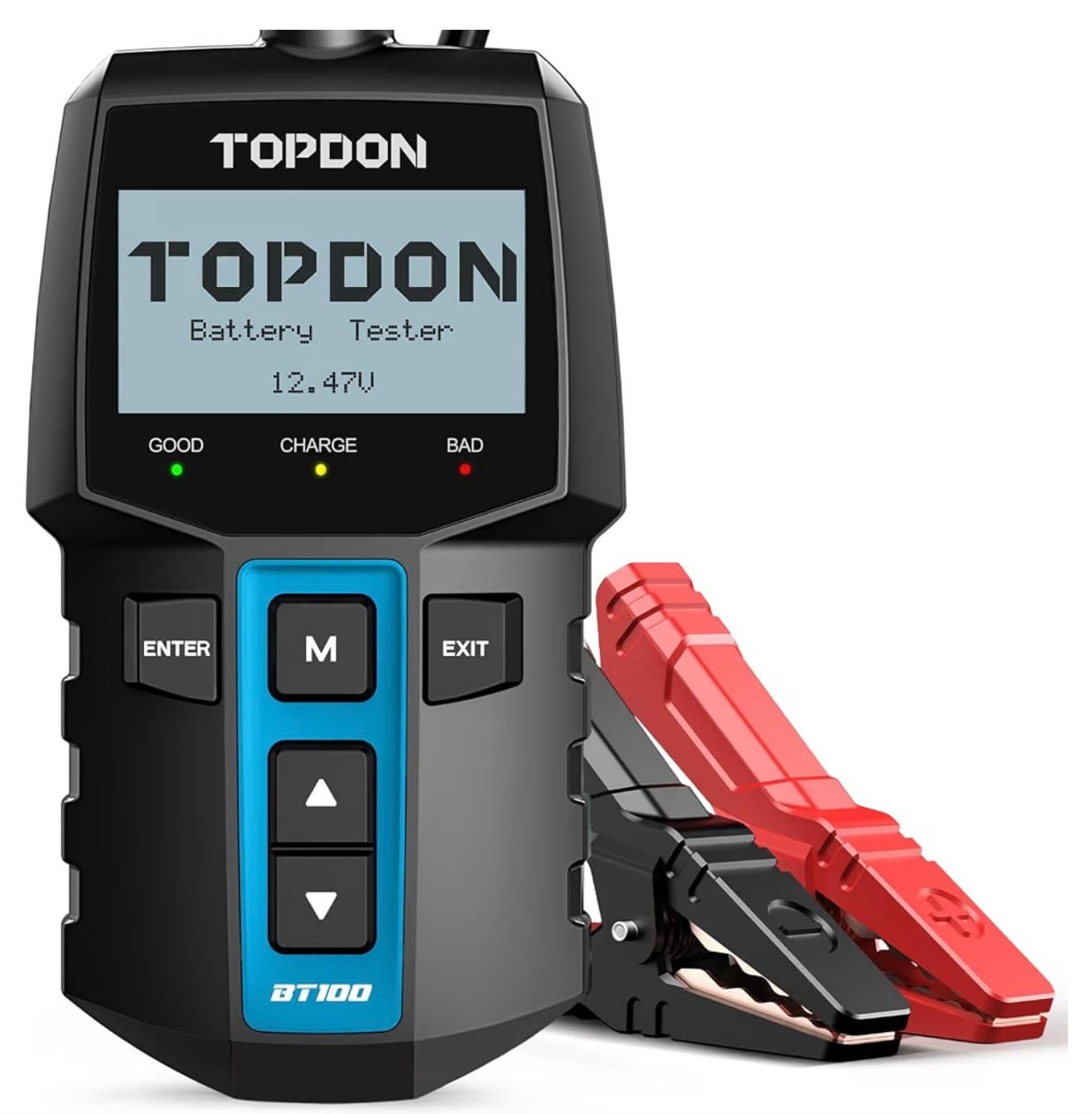
TOPDON BT100
Check on Amazon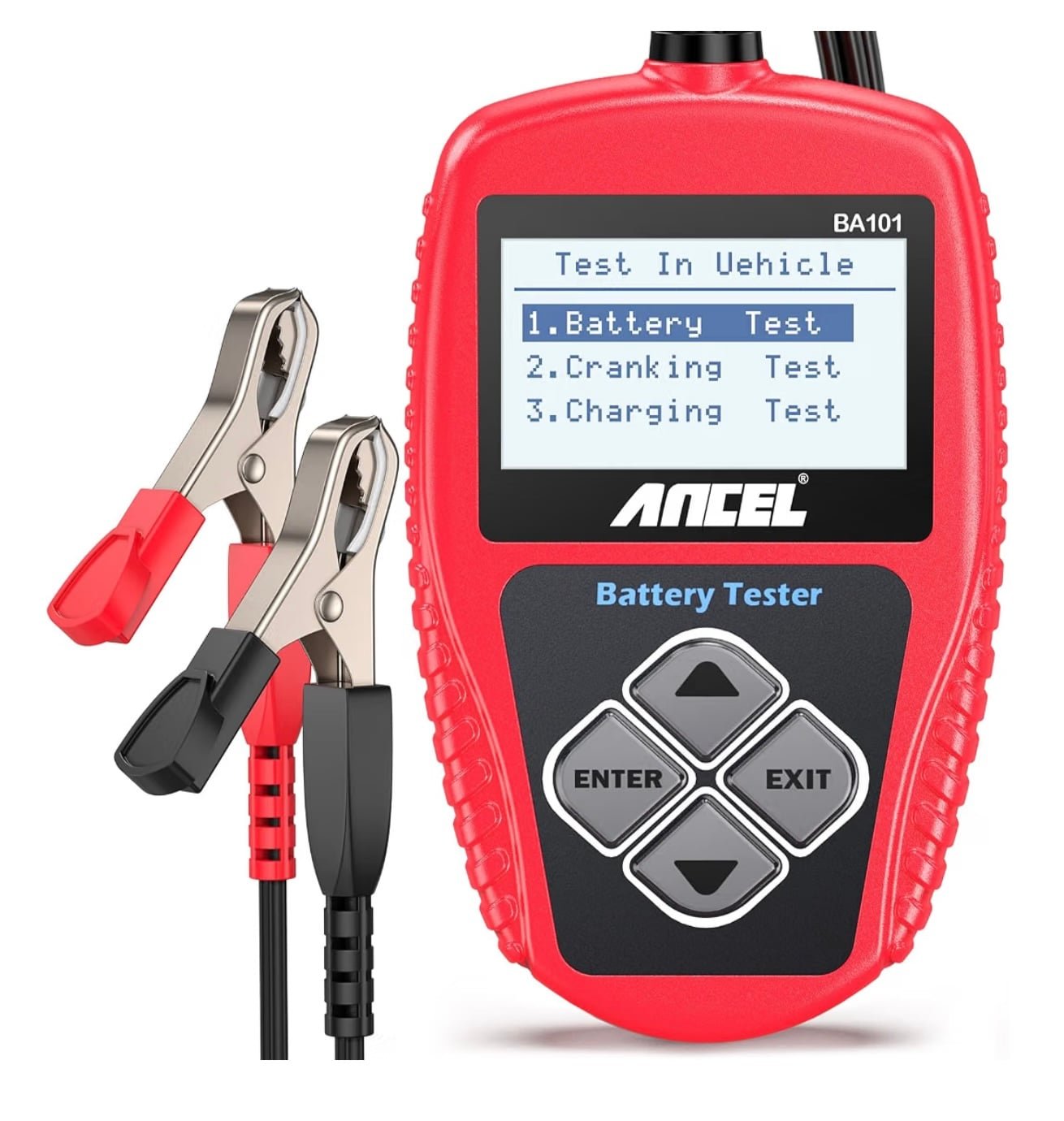
ANCEL BA101
Check on Amazon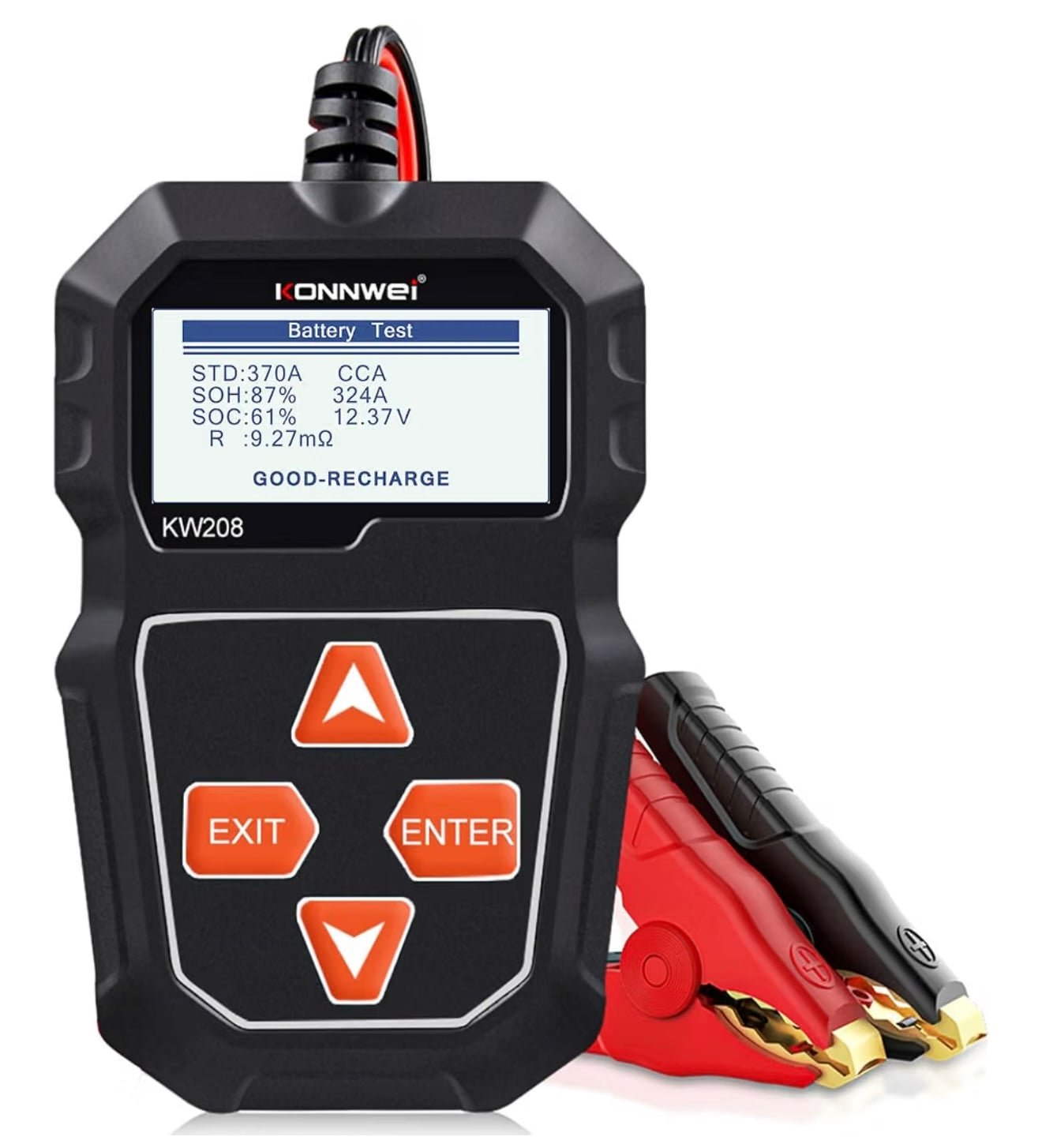
KONNWEI KW208
Check on Amazon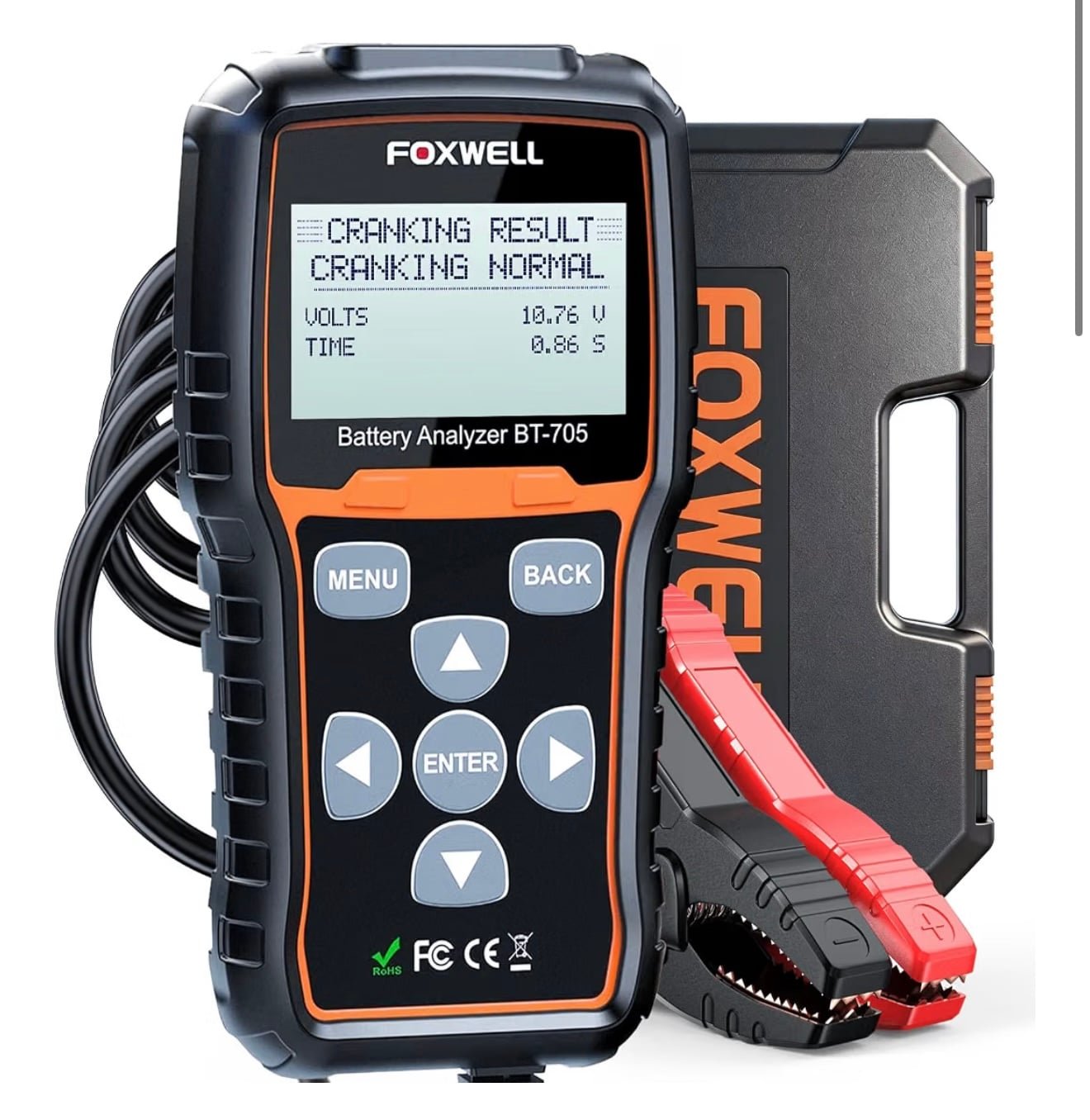
FOXWELL BT705
Check on Amazon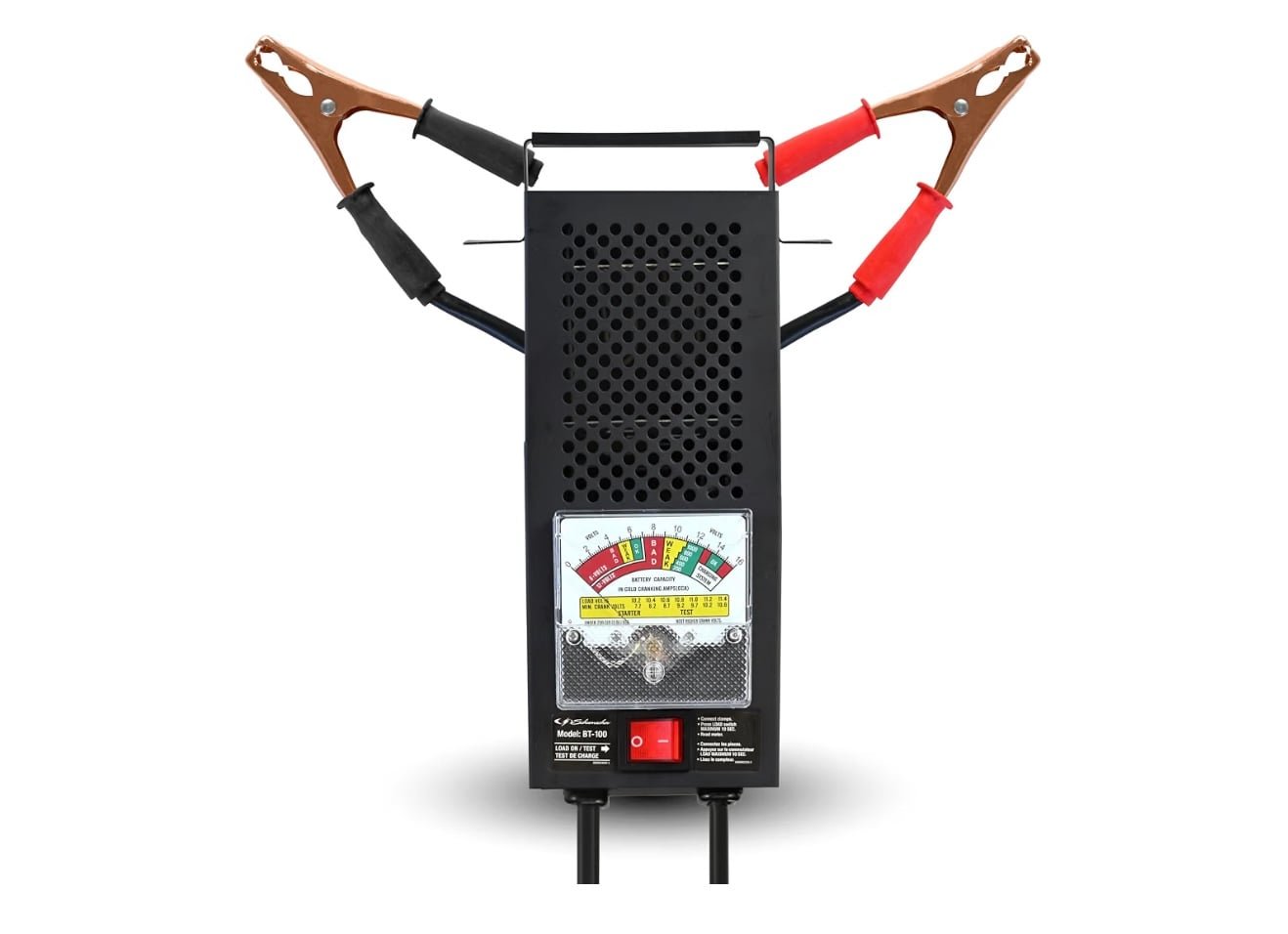
Schumacher BT-100
Check on Amazon1. TOPDON BT100: Best All-Around
The BT100 is a sensible first purchase for a household with ordinary 12V lead-acid starting batteries. It combines battery condition checks with cranking and charging-system routines. TOPDON lists an input rating range of 100 to 2,000 CCA and support for common automotive lead-acid designs, including AGM and EFB. This is a useful combination for someone who wants a single handheld tool instead of buying separate devices for each basic diagnostic task.
A key reason to choose this model is its approachable interface. The backlit screen and separate status indicators help a user work through a battery assessment without interpreting an analog needle. Its results can include estimated starting capability, state of charge, state of health and resistance. The cranking routine adds starting-voltage information, and the charging routine helps assess system behavior after the engine starts.
The tradeoff is that a digital result is an estimate of performance under specified conditions. It does not measure the full reserve capacity of a battery or guarantee the next start. Use the correct battery type and rating, and do not apply the device to a 24V system or a lithium battery unless its exact documentation explicitly permits it.
Best fit: A driver with one or more conventional 12V vehicles who wants a compact, repeatable screening tool before buying parts. See the TOPDON BT100 product specifications.
2. ANCEL BA101: Best Straightforward Alternative
The ANCEL BA101 addresses much the same everyday task as the TOPDON. ANCEL specifies 12V testing and a 100–2,000 CCA range. The listed battery families include conventional flooded batteries, AGM and gel designs. The instrument is intended to help evaluate battery condition and the vehicle's cranking and charging systems.
This is a reasonable alternative if the display layout, included instructions, seller support or current price is more attractive than the BT100. Neither a familiar name nor a larger number of advertised functions proves that one unit delivers more reliable diagnoses than the other. We did not conduct a comparative accuracy test.
One useful practice is to keep a written record of readings from the same vehicle over time. Record the date, battery rating, battery type, temperature and relevant results. If the vehicle gradually becomes harder to start, the records may help a technician understand how the condition changed. Do not compare percentages across brands as if they were calibrated to an identical standard.
Best fit: Owners who want a straightforward alternative for supported 12V batteries. Check the BA101 manufacturer listing and the exact variant before purchase.
3. KONNWEI KW208: Best for Voltage Visualization
The KW208 is another 12V digital tester, but its graphical display makes it worth a separate look. KONNWEI lists a color screen, real-time voltage waveform display and battery, starter and charging-system assessments. The manufacturer's technical description specifies a 100–2,000 CCA range and an 8–16V input range.
A graph can be helpful for understanding a changing electrical value rather than seeing only a single number. It is not equivalent to a professional oscilloscope or proof that a specific starter or alternator component has failed. Treat the visual display as an aid to troubleshooting rather than a complete diagnostic conclusion.
Cold-weather buyers should pay attention to the operating-temperature limit. The published range starts at 0°C, so a tool stored in a freezing garage may need to be brought within its permitted range before use. Do not assume that being marketed as a car tool means it can operate at every outdoor winter temperature.
Best fit: DIY users who prefer graphical voltage feedback and can work within the device's stated limits. The KONNWEI KW208 product page includes its technical information, despite an inconsistent page title.
4. FOXWELL BT705: Best for Mixed Vehicle Systems
The FOXWELL BT705 is a more specialized choice for owners who encounter both passenger vehicles and commercial equipment. Its documented applications include testing individual 12V lead-acid batteries and assessing 12V or 24V starting and charging systems. That distinction matters when a truck uses multiple 12V batteries to create a 24V electrical system.
A 24V system check is not the same as a 24V battery-health test. Follow the vehicle's service procedure for testing individual batteries within a bank, including isolation requirements. Do not disconnect or reconnect a commercial battery bank simply to experiment with a tester. A battery bank may have large available fault current, and a mistake can damage equipment or cause injury.
For an owner who only services a modern gasoline car or a 12V pickup, the additional system coverage may not justify the purchase. For a workshop that frequently encounters different electrical systems, the extra capability makes more sense. Compare the included leads, available support, warranty and instructions as well as the current seller price.
Best fit: Experienced DIY users or workshops with mixed electrical-system needs. Review the BT705 product documentation and verify the exact variant's voltage limits.
5. Schumacher BT-100: Best Traditional Load Tester
The Schumacher BT-100 differs from every digital unit on this list. It uses a physical load and an analog voltage meter to assess how a supported battery behaves under stress. Schumacher specifies a 50A test for 6V batteries and a 100A test for 12V batteries, with a listed battery rating limit of 1,000 CCA.
The benefit is direct observation of voltage behavior while the tool draws current. A traditional load tester may appeal to an experienced owner who prefers a simple instrument without menus. However, a fixed 100A load is not the same as a fully adjustable professional carbon-pile tester, and the result should be interpreted using the tool's own procedure, battery rating and temperature guidance.
The major tradeoff is heat. A resistive load tester heats up during use and must not be operated continuously. Read the exact model manual for maximum test duration and cooling intervals, use the insulated handle, and avoid contact with the hot housing. Do not load-test a damaged, leaking, swollen or frozen battery. Never connect the tester to an unsupported voltage or chemistry.
Best fit: An experienced home mechanic who specifically wants traditional applied-load testing. For a beginner who mainly wants routine screening, a digital unit may be easier to interpret. Refer to the Schumacher BT-100 specifications and operating manual.
Digital Battery Tester vs. Traditional Load Tester
Digital analyzers use electrical measurements and algorithms to estimate aspects of battery condition. They generally require less applied current than a traditional high-current load tester and make repeated screening convenient. Their interpretation depends on inputs such as the battery chemistry, rating standard, charge level and contact quality.
A resistive load tester deliberately draws substantial current for a brief period. Voltage response under that load offers another way to evaluate starting capability. The procedure requires more attention to heat, charge state and the limits of the tester. Neither instrument is a substitute for every specialized battery capacity or charge-acceptance test. Midtronics explains the differences between diagnostic technologies.
Tool | What it helps establish | What it does not establish |
|---|---|---|
Digital battery analyzer | Estimated condition and starting capability | Guaranteed remaining service life |
Traditional load tester | Voltage response under a specified load | Full reserve capacity or a definitive diagnosis of every fault |
Multimeter | Voltage at the measurement point | Complete battery health from resting voltage alone |
What to Look for Before Buying a Battery Tester
Match the voltage and battery chemistry. Read the battery label and vehicle manual; do not use a lead-acid tester on lithium or high-voltage EV batteries without explicit approval.
Check the supported rating standards. CCA, EN, DIN and other scales cannot always be substituted for one another. Use the rating and standard printed on the battery.
Choose the right test functions. Basic battery condition is different from cranking and charging assessment. Buy the capabilities you will actually use.
Consider clamp reach, screen readability and temperature limits. A tool is not useful if it cannot safely reach the approved test points.
Compare the exact seller listing, return policy and instructions. Similar model names can conceal different functions or revised hardware.
Understanding Battery Tester Results
State of charge (SOC): An estimate of how charged the battery is at that moment. A healthy battery can have a low state of charge after extended parking or short trips. That does not automatically make it defective.
State of health (SOH): An instrument-specific estimate of how the battery compares with expected performance. A high reading is not a promise that the battery will survive another winter, and a low reading needs context.
Cold cranking amps (CCA): A standardized starting-performance rating. A handheld analyzer generally estimates available CCA rather than reproducing a complete standardized cold laboratory test. Compare its estimate with the battery's actual label using the correct scale.
Internal resistance: A measurement that can offer clues about battery condition. Temperature, charge state, battery design and connection quality affect interpretation. Do not use a universal milliohm cutoff to replace every battery.
When a tester recommends charging and retesting, follow that instruction before making a purchase decision. A weak connection or the wrong battery input can also produce a misleading result. See Midtronics' diagnostic preparation guidance for discussion of these variables.
How to Use a Battery Tester Safely
These are general preparation principles, not a replacement for the exact tester and vehicle manuals. Automotive batteries can produce explosive gases and deliver extremely high fault currents. Work in a ventilated area, wear appropriate eye protection, remove metal jewelry and keep flames, sparks and loose tools away from the battery.
Park securely, switch off the vehicle and inspect the battery. Stop if it is damaged, leaking, swollen, frozen or unsafe to access.
Confirm the battery voltage, chemistry and rating, and identify manufacturer-approved connection points. Do not improvise on an EV, hybrid or unfamiliar battery bank.
Follow the tester's specified connection procedure and confirm that the clamps make clean contact. Keep leads clear of belts, fans and other moving parts.
Select the appropriate test mode, chemistry and rating standard. Follow the specific device's instructions, including any charge-state or surface-charge preparation.
Interpret the result in context. If required, safely charge and retest with compatible equipment. If starting or charging problems persist, seek a qualified diagnosis.
If a test requires the engine to run, do it outdoors or in an appropriately ventilated service area. Avoid exhaust exposure and moving machinery. Do not perform a high-current load test unless the battery, instrument and conditions meet the manufacturer's instructions.
Which Tool Should You Buy?
Situation | First choice to compare |
|---|---|
Family vehicles with 12V lead-acid batteries | TOPDON BT100 or ANCEL BA101 |
Prefer a graphical voltage display | KONNWEI KW208 |
Service both 12V and 24V electrical systems | FOXWELL BT705 |
Specifically want a 6V/12V physical load test | Schumacher BT-100 |
Occasional test without buying equipment | Professional battery check at a repair shop or participating auto parts store |
A tester is not always a necessary purchase. If you own a single vehicle and rarely diagnose batteries, a professional battery check may be more economical. For a household with several cars, recreational equipment or a seasonal vehicle, a compatible tester can be useful for recurring maintenance.
Battery Tester, Charger or Jump Starter?
Each device solves a separate problem. A tester helps determine condition. A charger restores energy to a compatible battery over time, while a portable jump starter supplies temporary starting assistance. A jump start does not establish that a battery is healthy, and a tester cannot recharge a battery.
For routine charging and storage, read our best car battery chargers and maintainers comparison. For unexpected starting trouble away from home, compare our portable jump starters for cars and SUVs. Build the rest of your roadside setup with the winter car emergency kit checklist and portable tire inflator guide.
Frequently Asked Questions
Is a digital car battery tester accurate?
It can provide useful screening results for a supported battery when used correctly. Accuracy varies with the instrument, battery condition, temperature and test inputs. A persistent starting fault or conflicting results warrants professional testing.
Can a battery tester identify a bad alternator?
A tester with a charging-system mode can flag abnormal charging behavior. The cause may be the alternator, regulator, wiring, connections or vehicle control strategy. Do not replace an alternator based only on a single generic voltage reading.
Can a battery show normal voltage and still be bad?
Yes. Resting voltage alone does not demonstrate that the battery can deliver sufficient starting current or maintain usable capacity under load.
Can I test an AGM battery?
Yes, with a tester that explicitly supports the battery's voltage, AGM design and rating standard. Select the appropriate AGM mode rather than treating every 12V battery as identical.
Do I need a 24V battery tester for a diesel pickup?
Not necessarily. Many diesel pickups use a 12V electrical system with two batteries connected in parallel. Check your exact vehicle configuration and service procedure instead of assuming two batteries means 24V.
Should I replace a battery when the tester says recharge?
Not automatically. Charge the battery using compatible equipment as directed, then retest. If it repeatedly loses charge or fails after charging, investigate the battery and the vehicle's electrical system.
Final Verdict
The TOPDON BT100 is our starting recommendation for a typical DIY household, with the ANCEL BA101 a close alternative. The KW208 adds a reason to compare its display and waveform features. The FOXWELL BT705 addresses mixed system voltages, while the Schumacher BT-100 offers a genuinely different testing method. Choose the device that fits your actual battery and maintenance habits, not the one with the most impressive marketing claim.
The most important takeaway is that a battery test is evidence, not a complete diagnosis. Combine correct testing with an understanding of charging history, connections and vehicle behavior before spending money on a replacement.
This post may contain affiliate links. We may earn a commission when you purchase through links on this site at no additional cost to you.


