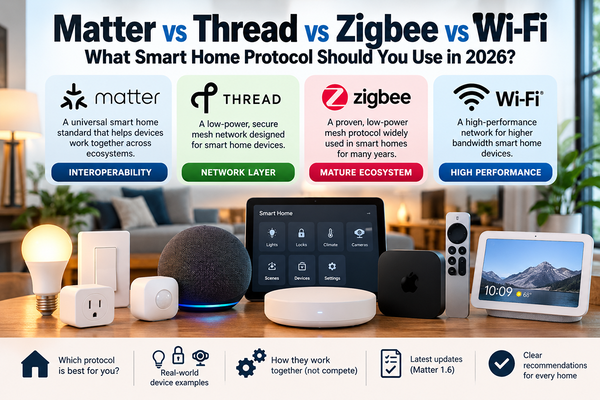
Matter, Thread, Zigbee, and Wi-Fi are often discussed as if they are competing versions of the same technology. They are not. Matter is primarily the interoperability layer that tells smart-home devices how to communicate at the application level. Thread and Wi-Fi are networking technologies that can carry Matter traffic. Zigbee is a mature low-power mesh technology with its own networking and application stack.
That distinction matters because the best smart-home setup in 2026 is usually not about choosing one winner. A reliable home may use Wi-Fi for cameras and displays, Thread for low-power sensors and locks, Zigbee for an established lighting or sensor network, and Matter across several of those devices to improve cross-platform compatibility.
If you are choosing the hardware that ties these technologies together, see Best Smart Home Hubs of 2026. If you are building from scratch, start with Smart Home for Beginners: The Complete 2026 Guide.
The Short Version
Choose Matter when you want better compatibility across ecosystems. Choose Thread when you want a low-power IP-based mesh for devices such as sensors, locks, plugs, and lighting. Choose Zigbee when you already have a strong Zigbee ecosystem or need a mature low-power mesh with broad device availability. Choose Wi-Fi when the device needs more bandwidth, simple direct network access, or does not benefit from a low-power mesh.
The All Guy take: Matter is not the replacement for Thread, Zigbee, or Wi-Fi. It is the layer that can make many smart-home devices easier to use across platforms. The transport underneath still matters.
Matter: The Compatibility Layer
Matter is an open smart-home protocol developed through the Connectivity Standards Alliance. It is designed to give supported devices a common local language across major ecosystems such as Apple Home, Amazon Alexa, Google Home, and Samsung SmartThings.
Matter does not replace the network underneath a device. Matter devices can communicate over Wi-Fi, Ethernet, or Thread. Bluetooth Low Energy is commonly used during setup and commissioning rather than as the normal control network.
This is why two products can both carry the Matter logo but behave differently on your network. A Matter-over-Wi-Fi smart plug joins your Wi-Fi network directly. A Matter-over-Thread lock joins a Thread mesh and needs a Thread border router to reach the rest of your IP network.
What You Need for Matter
You need a compatible Matter controller in the ecosystem you want to use. Depending on the platform, that controller may be a smart speaker, display, streaming box, hub, phone, or another always-on device. Matter-over-Thread devices also need access to a compatible Thread border router.
Matter can also bring older technologies into a Matter ecosystem through bridges. A Zigbee lighting bridge, for example, can expose supported Zigbee devices to Matter without converting each individual bulb into a native Matter device.
What Matter Does Well
Matter improves interoperability, encourages local control, and reduces the need for manufacturers to build completely separate integrations for each major platform. It also makes multi-ecosystem use more practical, which is useful in households where different people use different phones, assistants, or control apps.
What Matter Does Not Solve
Matter does not guarantee that every advanced manufacturer-specific feature will appear in every ecosystem. It also does not automatically fix weak Wi-Fi, poor Thread coverage, bad firmware, overloaded hubs, or incompatible electrical hardware. A Matter logo is a compatibility signal, not a promise that every device will behave identically everywhere.
Thread: The Low-Power IP Mesh
Thread is a low-power wireless mesh networking technology built on IPv6 and IEEE 802.15.4. It is designed for devices that need reliable connectivity without the power and bandwidth requirements of Wi-Fi.
Thread devices can form a mesh where powered devices help route traffic and extend coverage. Battery-powered devices can spend more time sleeping to preserve battery life. That architecture makes Thread a natural fit for sensors, locks, switches, plugs, shades, and other devices that send small amounts of data.
What Is a Thread Border Router?
A Thread border router connects the Thread mesh to the rest of the home IP network, typically Wi-Fi or Ethernet. It routes traffic rather than translating it into a proprietary protocol. Border-router functionality can be built into smart speakers, displays, routers, streaming boxes, hubs, and other always-on hardware.
A home can have more than one Thread border router. Multiple border routers can improve resilience because the Thread mesh does not have to depend on one proprietary gateway as a single point of failure.
Thread vs a Traditional Hub
Thread does not require a brand-specific bridge simply to translate Thread traffic. However, your smart-home ecosystem still needs a Matter controller or application platform if you are using Matter-over-Thread devices. That is why the words controller, border router, hub, and bridge should not be treated as interchangeable.
Zigbee: The Mature Low-Power Mesh
Zigbee is a long-established low-power mesh technology widely used in lighting, sensors, plugs, switches, locks, and building automation. It includes both networking and application-layer definitions, which differs from Thread's role as an IP networking technology.
Zigbee's biggest strength in 2026 is maturity. There is an enormous installed base, a large product ecosystem, and years of real-world deployment behind it. A well-designed Zigbee network can be extremely reliable, particularly when enough powered routing devices are distributed through the home.
Does Zigbee Need a Hub?
In most consumer smart homes, Zigbee devices connect through a compatible hub, coordinator, or bridge. Philips Hue Bridge, Aqara hubs, Hubitat, and certain SmartThings or Alexa hardware are familiar examples of products that can manage Zigbee devices.
That hub requirement is not automatically a disadvantage. A dedicated Zigbee network can keep dozens of low-bandwidth devices off your Wi-Fi while giving the platform a stable local mesh. The tradeoff is that hub choice can affect feature availability and ecosystem integration.
Is Zigbee Obsolete Because of Matter?
No. Matter does not make existing Zigbee devices useless. Matter supports bridges, allowing supported Zigbee devices to appear inside a Matter ecosystem through compatible bridge hardware. If your Zigbee lighting, sensors, and switches are reliable, there is usually little reason to replace them just to change logos.
Wi-Fi: The Familiar High-Bandwidth Option
Wi-Fi remains the most familiar smart-home network because nearly every home already has it. It is the natural fit for devices that need higher bandwidth, including cameras, video doorbells, displays, speakers, televisions, and appliances with larger data requirements.
Wi-Fi smart devices can be easy to understand because they connect directly to the home network without a separate low-power radio hub. Matter-over-Wi-Fi devices also benefit from Matter interoperability while using the same Wi-Fi infrastructure already present in the house.
Where Wi-Fi Becomes a Problem
Wi-Fi is not automatically the best choice for every sensor, switch, or battery device. Large numbers of inexpensive IoT devices can make network management more difficult, especially when the router has weak coverage, poor client handling, crowded 2.4 GHz spectrum, or inconsistent firmware.
Battery life is another reason small sensors often favor Thread or Zigbee. Wi-Fi can consume more power than low-power mesh technologies, although actual performance depends on the device design and Wi-Fi implementation.
Matter vs Thread: They Are Not Competitors
This is the most important comparison in the article. Matter defines how supported smart-home devices and ecosystems communicate. Thread provides one of the networks that Matter can run across. A Matter-over-Thread device uses both.
Think of Matter as the language and Thread as one of the roads. The same Matter language can also travel over Wi-Fi or Ethernet.
Thread vs Zigbee
Thread and Zigbee both use low-power mesh networking and are commonly associated with IEEE 802.15.4 radios, but their architectures are different. Thread is IP-based and extends the home's IP network through a border router. Zigbee uses its own stack and typically connects into the wider home network through a coordinator, hub, or bridge.
Thread is attractive for newer Matter-focused builds because it fits directly into an IP-based architecture. Zigbee remains attractive for mature ecosystems, large existing device libraries, and platforms that already manage Zigbee extremely well.
Zigbee vs Wi-Fi
Zigbee is generally better suited to low-power mesh devices that send small amounts of data. Wi-Fi is better suited to high-bandwidth devices and products that benefit from direct IP connectivity. A home full of Zigbee sensors can operate without placing each sensor directly on Wi-Fi, while a security camera needs the throughput that Zigbee was never designed to provide.
Thread vs Wi-Fi
Thread and Wi-Fi are complementary. Wi-Fi handles high-bandwidth network traffic well. Thread is optimized for low-power IoT devices and mesh coverage. Many modern smart homes need both.
A useful rule of thumb is that cameras, TVs, speakers, and large appliances usually belong on Wi-Fi or Ethernet, while locks, contact sensors, motion sensors, switches, and similar low-data devices are strong candidates for Thread or Zigbee.
Which Protocol Is Best for Smart Bulbs?
There is no universal answer. Direct Wi-Fi bulbs are easy to set up and do not require a dedicated lighting bridge. Thread bulbs can fit well into a Matter-over-Thread home. Zigbee bulbs remain excellent when paired with mature systems such as Philips Hue or Aqara.
For specific products and platform requirements, see Best Smart Light Bulbs of 2026.
Which Protocol Is Best for Smart Switches?
Smart switches are often more dependent on wiring, load compatibility, and platform architecture than protocol alone. Lutron uses its own Clear Connect system, while other switches use Wi-Fi, Thread, Zigbee, or a combination depending on the model.
Compare the current options in Best Smart Light Switches of 2026.
Which Protocol Is Best for Smart Plugs?
Wi-Fi and Matter-over-Wi-Fi are simple choices for a few plugs. Thread plugs can become useful powered routers inside a Thread mesh. Zigbee plugs can strengthen an existing Zigbee mesh while providing automation and, on some models, energy monitoring.
See Best Smart Plugs of 2026 for current examples.
Which Protocol Is Best for Sensors and Locks?
Thread and Zigbee are particularly well suited to sensors and locks because low power matters more than bandwidth. Matter-over-Thread is increasingly attractive for new cross-platform devices, while Zigbee remains a strong choice when the home already has a mature Zigbee hub and mesh.
What Should a New Smart Home Use in 2026?
For a new build, start with a reliable Wi-Fi network and one primary smart-home ecosystem. Make sure that ecosystem has the Matter controller and Thread border-router capabilities you need before buying Matter-over-Thread devices. Use Wi-Fi for higher-bandwidth products, Thread for low-power Matter devices where it makes sense, and do not hesitate to use Zigbee if a mature Zigbee product or ecosystem solves the problem better.
Avoid collecting protocols for their own sake. The goal is not to own Matter, Thread, Zigbee, and Wi-Fi devices. The goal is to create a system that is reliable, understandable, and easy for everyone in the house to use.
What If You Already Have Zigbee Devices?
Keep them if they work. Replacing a reliable Zigbee network just to move to Matter or Thread can cost money without improving the actual experience. Instead, look for a Matter bridge or a hub that can integrate the existing Zigbee network with the rest of your smart home.
What If You Have Too Many Wi-Fi Devices?
Do not assume the protocol is automatically the problem. Start by improving coverage, access-point placement, router capacity, and channel conditions. For future low-power devices, Thread or Zigbee can reduce the number of devices that need to associate directly with Wi-Fi.
Matter 1.6: What Changed in 2026
The Connectivity Standards Alliance released Matter 1.6 in June 2026. Rather than focusing primarily on a large wave of new device categories, the release improves commissioning, multi-ecosystem device management, device capability reporting, operational-state handling, and context-aware control.
That direction is important because the long-term value of Matter depends as much on smoother setup and consistent multi-platform behavior as it does on adding more device types.
Bottom Line
Matter, Thread, Zigbee, and Wi-Fi are tools for different layers of the smart home. Matter improves interoperability. Thread provides a low-power IP mesh. Zigbee provides a mature low-power mesh with a huge installed base. Wi-Fi provides familiar IP connectivity and the bandwidth needed by cameras, displays, and other data-heavy devices.
The best 2026 smart home is usually hybrid: strong Wi-Fi underneath everything, Matter where cross-platform compatibility helps, Thread for appropriate low-power devices, and Zigbee wherever an established Zigbee ecosystem already delivers reliable results.
Next, compare the hardware that connects all of this in Best Smart Home Hubs of 2026 or return to the Smart Home Start Here hub.
This post may contain affiliate links. We may earn a commission when you purchase through links on this site at no additional cost to you.


