
This article contains affiliate links. We may earn a commission from qualifying purchases.
As an Amazon Associate I earn from qualifying purchases.
Airing down is one of the easiest ways to improve traction and ride quality when you leave pavement. The part people sometimes forget is that those tires still have to be aired back up before sustained highway driving.
That makes a portable air compressor one of the few pieces of overlanding equipment you may actually use on almost every trip.
The challenge is that compressor specs can be misleading if you compare only maximum PSI or the biggest CFM number on the box. Tire size, airflow at working pressure, duty cycle, power draw, hose length and whether you fill one tire or several at once all matter.
The All Guy takeaway: Buy the compressor for your tire size and air-up routine, not the biggest number in the product listing.
This guide compares seven strong options from ARB, MORRFlate, Smittybilt and VIAIR. We have not personally tested every compressor in this roundup. Recommendations are based on manufacturer specifications, intended use, system design and practical fit for different overlanding setups.
As an Amazon Associate I earn from qualifying purchases. Some links below are affiliate links, while manufacturer-direct links are included where that is the better source.
If you're building your first rig, pair this guide with our Best Overlanding Gear in 2026: 18 Essentials Worth Carrying and our Overlanding for Beginners guide.
Quick Comparison: Best Overlanding Air Compressors
Compressor | Published Airflow | Best Fit |
|---|---|---|
ARB Twin Motor Portable CKMTP12 | 6.16 CFM at 0 PSI; 4.68 CFM at 29 PSI | Premium traditional portable system |
MORRFlate TenSix PSI Pro Gen2 | 10.6 CFM at 0 PSI; 6.5 CFM at 30 PSI | Multi-tire inflation systems |
Smittybilt 2782 Dual Head | 10.6 CFM maximum | High-output value |
VIAIR 400P EF Automatic | Enhanced-flow 400P platform | Balanced automatic portable setup |
VIAIR 400P Automatic | 2.30 CFM at 0 PSI | Proven traditional VIAIR option |
Smittybilt 2781 | 5.6 CFM maximum | Midrange option for larger tires |
VIAIR 400P EF Portable | Enhanced-flow 400P platform | Manual inflator setup |
What Matters Most in an Overlanding Air Compressor
A compressor for a passenger car emergency kit is not automatically a good compressor for airing four 35-inch all-terrain tires back up after a trail day. The workload is completely different.
Airflow at pressure matters more than a headline CFM number
Manufacturers often advertise airflow at 0 PSI because that produces the largest number. Useful comparisons also look at airflow as pressure builds. A compressor that maintains strong output at 30 or 40 PSI can behave very differently from one whose output falls quickly under load.
Duty cycle tells you how long it can work
Duty cycle describes how long a compressor can operate within a stated period and condition before it needs time to cool. Large tires and repeated air-ups create heat, so duty cycle becomes more important as tire size and vehicle count increase.
Single-tire and multi-tire systems are different use cases
Some compressors are built around a conventional one-tire-at-a-time hose. Others, especially MORRFlate's TenSix, are designed to move a lot of air through a multi-tire hose system. A huge airflow number does not mean much if the compressor and hose arrangement are poorly matched.
Power draw and connection type matter
High-output 12V compressors can pull substantial current. Many serious off-road compressors connect directly to the battery rather than a cigarette-lighter outlet. Make sure your electrical system, cables and connection method are appropriate for the compressor.
Hose reach can make or break the experience
A compressor can have excellent performance and still be frustrating if the hose does not comfortably reach every tire. Pay attention to the total hose arrangement, especially on long-wheelbase trucks and full-size SUVs.
1. ARB Twin Motor Portable CKMTP12
Best premium traditional portable compressor
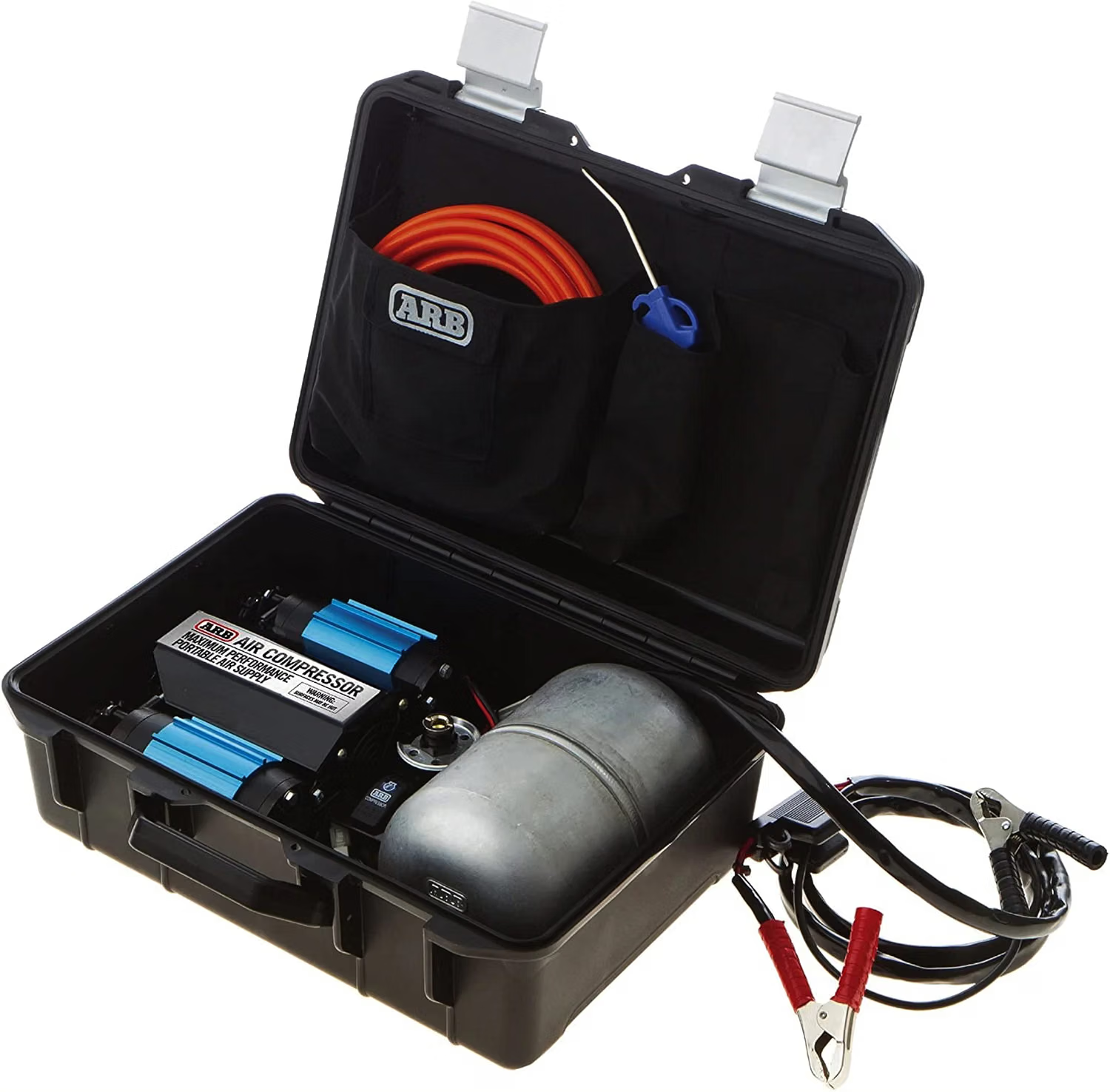
ARB's CKMTP12 is the premium conventional portable option in this group. ARB publishes 6.16 CFM at 0 PSI and 4.68 CFM at 29 PSI, along with a 100% duty cycle and 150 PSI maximum pressure.
That combination makes sense for larger truck tires, repeated air-ups and owners who care more about inflation performance than having the smallest compressor behind the seat.
The tradeoff is obvious: the complete portable kit is large and heavy compared with single-motor alternatives. ARB lists the kit around 33 pounds, and the twin-motor design can draw roughly 69 amps at maximum load. This is serious equipment, not a glove-box inflator.
Who it fits: drivers with larger tires, frequent off-road use or a preference for a proven high-output portable system.
2. MORRFlate TenSix PSI Pro Gen2
Best for multi-tire inflation systems
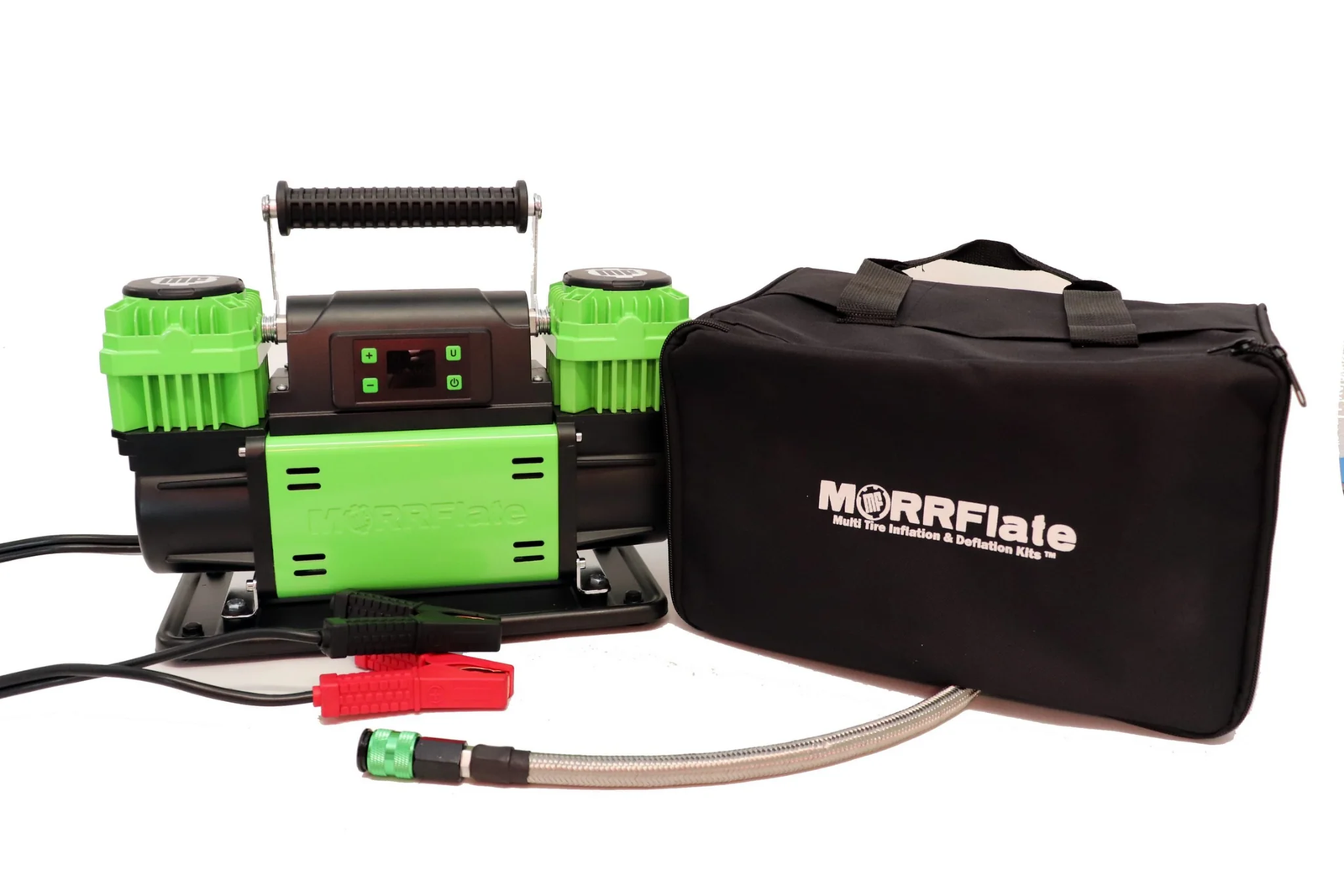
The TenSix PSI Pro Gen2 approaches the problem differently. MORRFlate publishes 10.6 CFM at 0 PSI and 6.5 CFM at 30 PSI, but the more important detail is how the company intends you to use that airflow.
MORRFlate specifically optimizes the TenSix around airing multiple tires at the same time through one of its multi-tire hose systems. That can reduce the amount of moving from wheel to wheel and lets paired tires equalize while filling.
This is the compressor in the group where simply comparing the 10.6 CFM headline number with another 10.6 CFM compressor would be misleading. The whole system matters.
Who it fits: overlanders who want a dedicated two- or four-tire air-up workflow and value speed and convenience more than using a traditional one-tire hose.
3. Smittybilt 2782 Dual Head 10.6 CFM
Best high-output value option
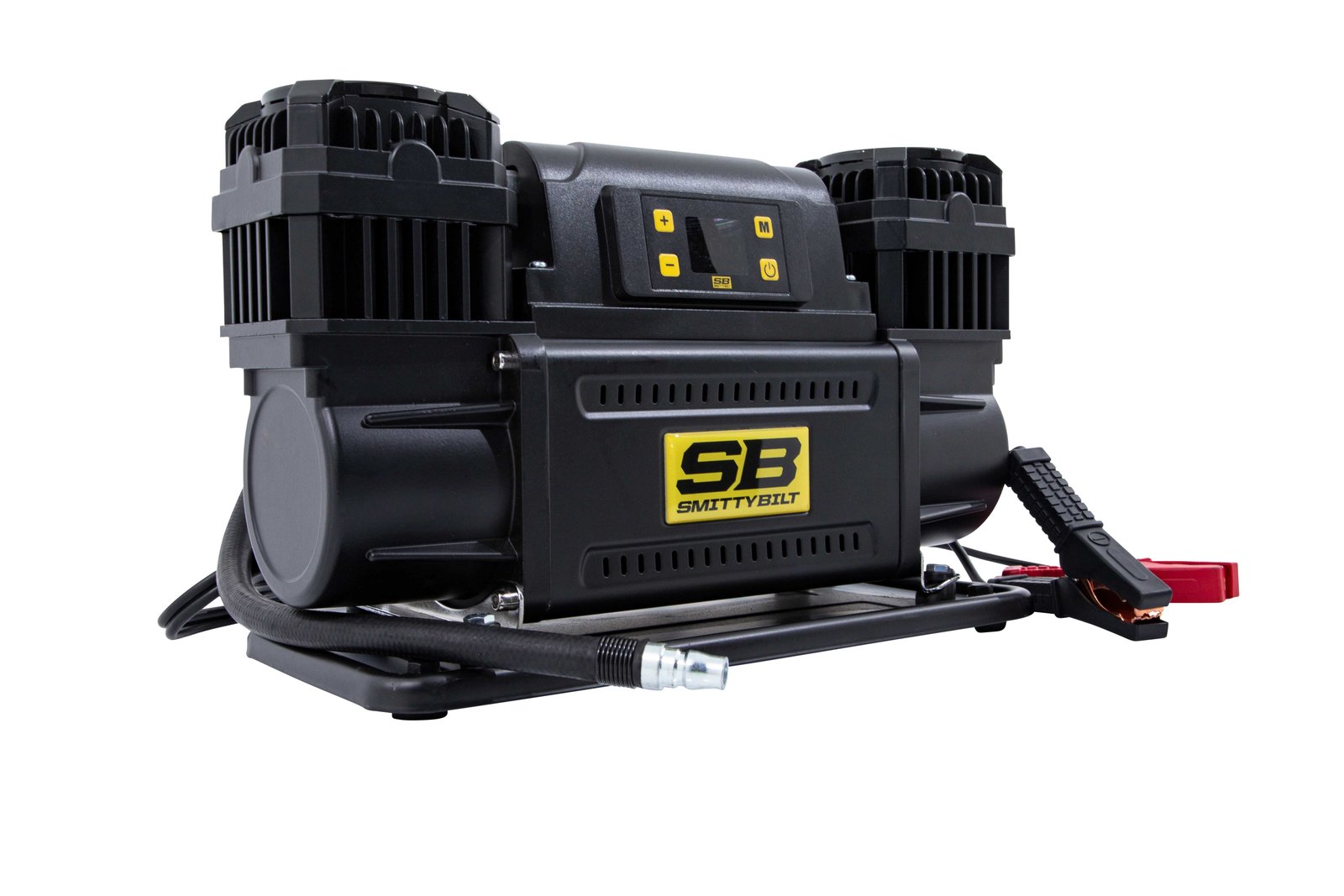
The Smittybilt 2782 is another dual-head high-output compressor, but it is presented as a more conventional portable inflation system. Smittybilt lists 10.6 CFM maximum airflow, a 26-foot hose, thermal cutoff and automatic pressure shutoff.
Its published duty cycle is 25 minutes at 40 PSI. That is an important distinction from the ARB Twin's 100% duty-cycle positioning and a reminder that identical-looking airflow numbers do not tell you how two compressors behave during repeated use.
Who it fits: truck owners who want a lot of advertised airflow and a full portable setup without stepping into the price tier of the ARB Twin.
4. VIAIR 400P EF Automatic
Best balance of portability and automatic operation
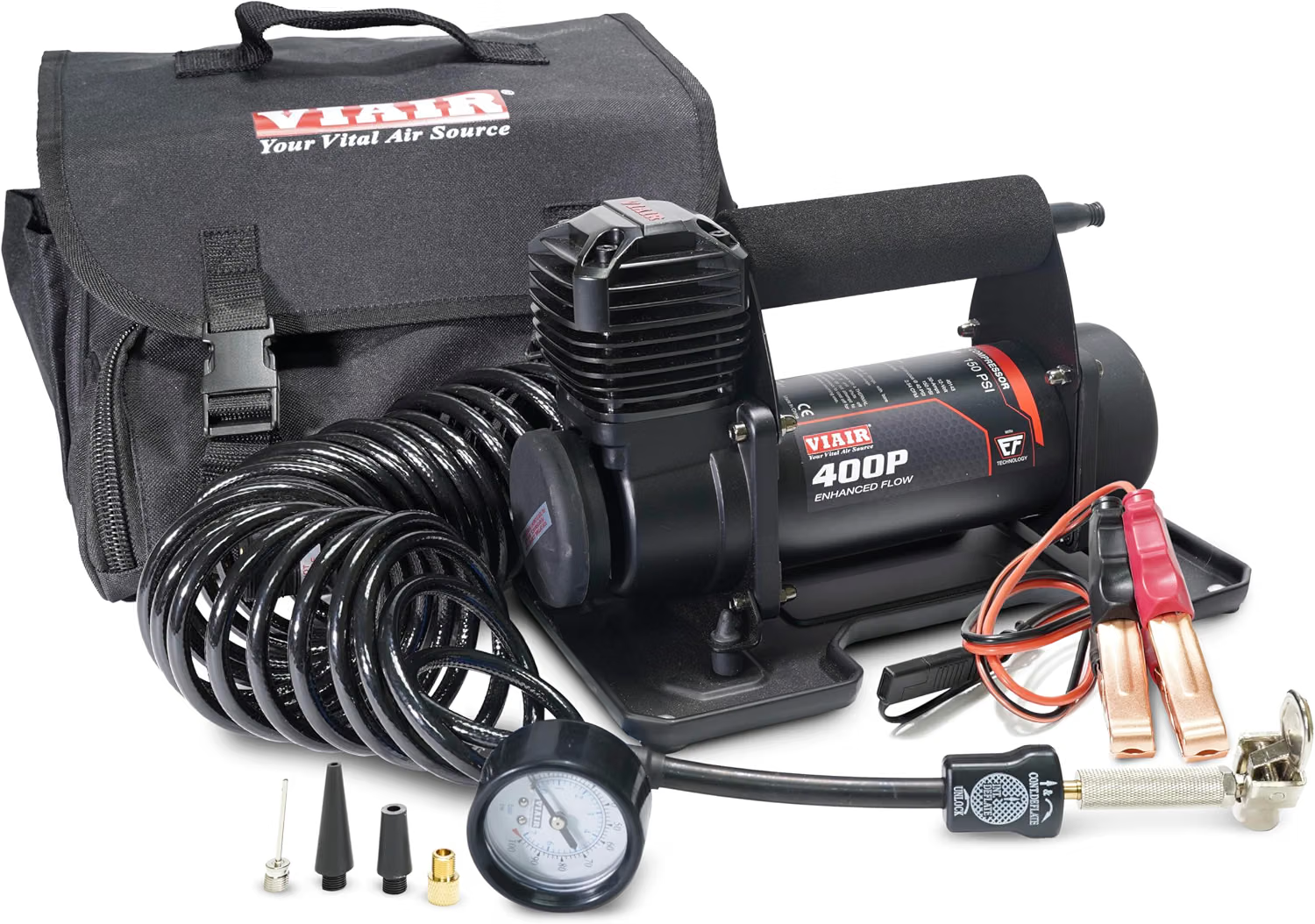
VIAIR's 400P EF Automatic sits in an appealing middle ground for someone who wants serious portable inflation without carrying a twin-motor case.
VIAIR publishes a 100% duty cycle at 40 PSI, 33% at 100 PSI, 150 PSI maximum pressure and 30-amp maximum draw. The compressor itself is listed at roughly 10.35 pounds, which is substantially easier to store and move than larger dual-motor kits.
The Automatic version uses an inflation gun and 30-foot air hose. Automatic shutoff means the compressor can stop running when you release the trigger, making it easier to move between tires without manually switching the compressor off each time.
Who it fits: overlanders who value compact storage, manageable electrical demand and convenient automatic operation.
5. VIAIR 400P Automatic
Best proven traditional VIAIR option
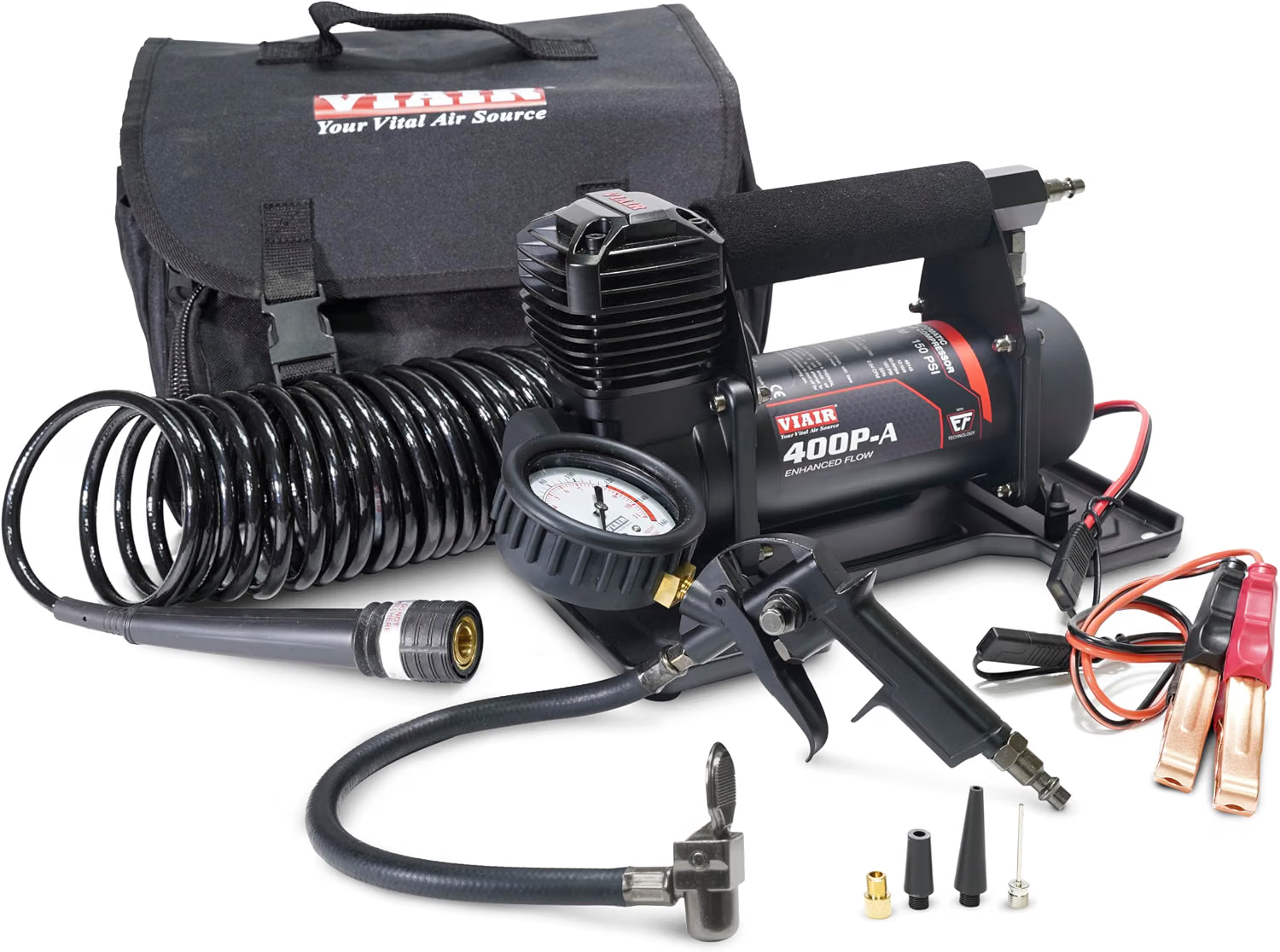
The standard 400P Automatic has been a familiar option in VIAIR's portable lineup. VIAIR lists 2.30 CFM at 0 PSI, a 33% duty cycle at 100 PSI, 150 PSI maximum pressure and 30-amp maximum draw.
It supports large off-road tires and includes a 30-foot hose with automatic shutoff. Compared with the newer EF model, it is the more traditional 400P choice rather than the version built around VIAIR's enhanced-flow architecture.
Who it fits: buyers who want an established automatic-shutoff VIAIR package and do not need the newer EF design.
6. Smittybilt 2781 5.6 CFM

Best midrange option for larger tires
The Smittybilt 2781 sits below the dual-head 2782 in output but still targets serious truck and off-road use. Smittybilt lists 5.6 CFM maximum airflow and positions the compressor for large tires, including 35- and 37-inch applications.
Smittybilt publishes an example air-up time of roughly 2 minutes 22 seconds for a 35-inch tire under its stated test conditions. Treat manufacturer inflation times as comparison data rather than a guarantee, because starting pressure, target pressure, tire volume, temperature and battery voltage all change real-world results.
Who it fits: someone running larger tires who wants a conventional portable compressor without moving all the way into a dual-head unit.
7. VIAIR 400P EF Portable

Best for a simpler manual inflator setup
The 400P EF Portable uses the newer EF platform but skips the automatic inflation-gun setup. VIAIR lists the same 100% duty-cycle rating at 40 PSI, 33% at 100 PSI, 150 PSI maximum pressure and 30-amp maximum draw as the EF Automatic.
The practical difference is the hose and control arrangement. The manual version uses a 25-foot inflator and deflator hose rather than the Automatic model's 30-foot hose and trigger-based automatic operation.
Who it fits: buyers who like the EF platform but prefer a straightforward manual inflation setup and do not care about automatic shutoff.
Which Compressor Fits Your Tire Size?
Tire diameter gets most of the attention, but actual tire volume is what the compressor has to fill. A wide 35-inch tire can contain significantly more air than a narrow tire of similar diameter.
For stock-size and moderate all-terrain tires
You may not need a huge dual-motor compressor. A compact VIAIR-style system can be easier to store, lighter to handle and fully adequate if you are only changing pressure modestly.
For 33- to 35-inch tires
This is where airflow and duty cycle become much more noticeable. The VIAIR 400P family, Smittybilt 2781 and larger systems begin to make more sense depending on how often you air down and how impatient you are at the end of a trail.
For 35- to 37-inch tires and frequent use
High-output options such as the ARB Twin, MORRFlate TenSix or Smittybilt 2782 become easier to justify. You are moving a lot more air, and the difference between a compressor designed for repeated work and a small emergency inflator becomes obvious.
One Tire at a Time or All Four?
A traditional portable compressor is simple: connect to the battery, run the hose to a tire, fill it, then move to the next wheel.
A multi-tire system connects two or four tires together. That can let pressures equalize and allows a high-flow compressor to fill several tires without repeatedly moving the hose.
The tradeoff is more hose, more fittings, more storage and a higher total system cost. For someone who airs down a few times per year, that may be unnecessary. For someone who airs down every weekend, the convenience can be worth it.
Portable Compressor vs Onboard Air
Portable systems are usually the right place to start because they require little or no permanent installation and can move between vehicles.
Onboard air starts making sense when you want permanent plumbing, quick-connect fittings, air lockers, an air tank or a compressor that is always mounted and ready. The downside is installation complexity and less flexibility if you change vehicles.
For a first overlanding build, I would usually learn with a portable compressor before committing to a permanent air system.
What I Would Choose by Use Case
Large tires and frequent trail use: ARB Twin Motor Portable CKMTP12.
Dedicated four-tire setup: MORRFlate TenSix PSI Pro Gen2.
High-output conventional system at a lower price tier: Smittybilt 2782.
Balanced size, duty cycle and automatic operation: VIAIR 400P EF Automatic.
Traditional VIAIR automatic setup: VIAIR 400P Automatic.
Midrange compressor for larger tires: Smittybilt 2781.
Simple manual enhanced-flow VIAIR setup: VIAIR 400P EF Portable.
Those are use-case fits, not claims that one product universally beats the others. Tire size, air-up frequency, available storage and the way you prefer to inflate tires should drive the decision.
Air Compressor Gear Worth Carrying With It
Accurate tire-pressure gauge
Tire deflator
Tire repair kit
Valve-core tool and spare valve components
Work gloves
Flashlight or headlamp
The compressor is part of a tire-management system. A high-end compressor does not help much if you cannot accurately measure pressure or repair a basic puncture.
Frequently Asked Questions
How much CFM do I need for overlanding?
There is no single CFM requirement. Larger tires and larger pressure changes benefit from more airflow, but airflow at working pressure, duty cycle and hose design matter alongside the maximum CFM number.
Is 150 PSI important for off-road tires?
Usually not by itself. Most truck and SUV tires are inflated far below 150 PSI. Maximum PSI can indicate capability, but airflow in the pressures you actually use is much more helpful for estimating air-up performance.
Can I run a high-output compressor from a 12V accessory socket?
Many high-output compressors draw too much current for a typical accessory socket and are designed to connect directly to the vehicle battery. Follow the manufacturer's power and connection instructions for the exact compressor.
Do I need a compressor if I never air down?
It can still be valuable for topping up tires after a slow leak or tire repair, but the case for a large premium overlanding compressor is much weaker if you rarely change pressure off-road.
Should I buy onboard air instead?
Onboard air makes sense for frequent use, permanent plumbing, air lockers or air tanks. Portable systems are easier to install, move between vehicles and replace, which is why they are a good starting point for many builds.
Final Take
A portable compressor is one of the most practical overlanding upgrades because it supports a basic trail technique you may use constantly: adjusting tire pressure for the terrain and putting those tires back at road pressure when the trail ends.
For larger tires and repeated use, the ARB Twin makes a strong premium case. MORRFlate's TenSix is more specialized and especially compelling when paired with a multi-tire hose system. VIAIR's 400P family offers smaller, easier-to-store choices, while the two Smittybilt compressors add high-output and midrange alternatives.
The right compressor is the one that fits your tire volume, electrical system, storage space and how often you actually air down. Buy around that routine and the compressor is far more likely to become gear you use instead of gear you simply carry.
Next in the Overlanding cluster: recovery boards, portable power stations, GMRS radios and 12V refrigerators. Start with our Best Overlanding Gear in 2026 hub to build the rest of the system.
This post may contain affiliate links. We may earn a commission when you purchase through links on this site at no additional cost to you.


