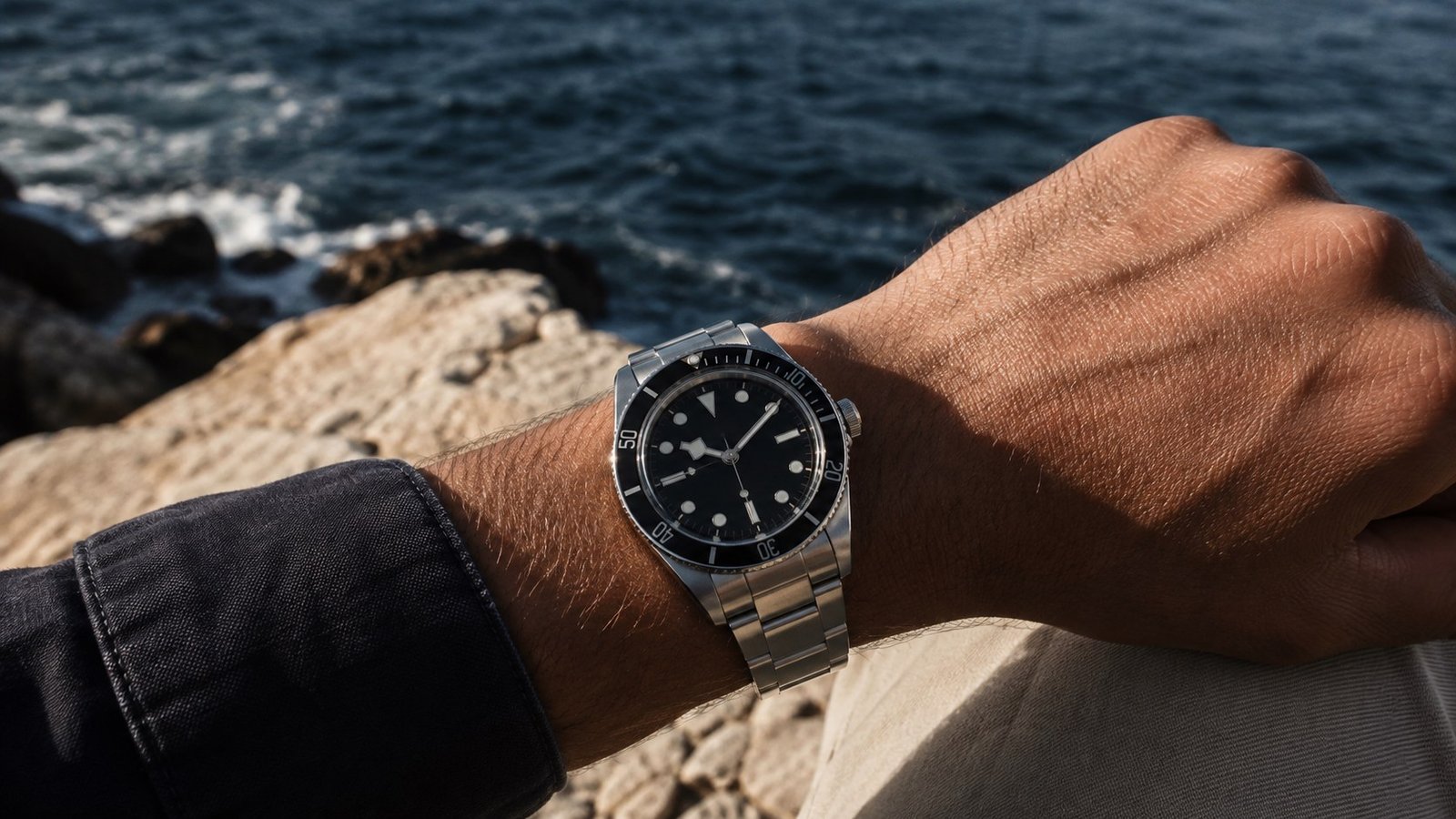
A luxury dive watch is one of the easier expensive purchases for a guy to rationalize.
It is mechanical. It is durable. You can wear it with a T-shirt, a suit, swim trunks or a winter jacket. Most have enough water resistance to handle far more than everyday life will throw at them, and the basic design has barely gone out of style in seventy years.
That still does not mean every $5,000 dive watch is a good buy.
Once you move beyond affordable tool watches, you are paying for a mix of movement quality, finishing, materials, brand history, design, service network and, whether enthusiasts like admitting it or not, the name on the dial.
The useful question is not simply, “What is the best luxury dive watch?” It is: What are you actually getting for the extra money, and which watch fits the way you will really wear it?
Quick takeaway: For most guys buying their first serious luxury diver, wrist comfort, bracelet adjustment, movement reliability and whether you actually like wearing the design matter more than extreme depth ratings or obscure technical features.
Want the broader buying path? Start with our Watches Start Here hub for everyday watches, budget guides, field watches, and dive-watch buying paths.
What Actually Makes a Luxury Dive Watch Better?
The basic recipe for a dive watch is not complicated. You generally want a highly legible dial, strong water resistance, a secure crown and a rotating timing bezel. Plenty of relatively inexpensive watches provide all of that.
Luxury watches have to justify themselves somewhere else.
The differences tend to show up in five places: case and bracelet finishing, movement design, materials, comfort and long-term ownership experience.
A $4,000 watch may have tighter tolerances in the bracelet, a better clasp, a more refined movement and significantly more case finishing than a $500 watch. A $10,000 watch may add a stronger brand reputation and substantially better secondary-market demand. A $20,000 watch may offer more elaborate movement finishing and more handwork.
None of those automatically makes it more useful at telling time. That is why buying based solely on specifications is one of the easiest mistakes to make.
Best Luxury Dive Watches at a Glance
Watch | Approx. retail | Size | Water resistance | Power reserve | Best for |
|---|---|---|---|---|---|
Oris Aquis Date Calibre 400 | ~$3,900–$4,000 | 41.5 mm | 300 m | 120 hrs | Movement value |
Longines Legend Diver | ~$3,850 | 39 mm | 300 m | 72 hrs | Vintage-inspired style |
TAG Heuer Aquaracer Professional 300 | ~$4,350+ | 42 mm | 300 m | 80 hrs | Modern sports-watch feel |
Tudor Pelagos 39 | $6,025 | 39 mm | 200 m | 70 hrs | Everyday tool watch |
Breitling Superocean Heritage B31 | $6,500 | 40 mm | 200 m | 78 hrs | Dressier daily wear |
Rolex Submariner | $10,050 | 41 mm | 300 m | 70 hrs | Iconic all-rounder |
Blancpain Fifty Fathoms Automatique | ~$22,400 | 42.3 mm | 300 m | 120 hrs | High-end horology |
Prices change, so treat the figures above as current reference points rather than permanent numbers.
Best Value Movement: Oris Aquis Date Calibre 400
If you care more about what is happening inside the watch than impressing anyone across the room, the Oris Aquis Calibre 400 deserves serious attention.
The 41.5 mm steel Aquis offers 300 meters of water resistance and a 120-hour, or five-day, power reserve. Oris also offers an extended 10-year warranty on Calibre 400 models after registration.
That five-day reserve is genuinely useful. Take the watch off Friday night, wear something else all weekend, and there is a good chance the Oris is still running Monday morning.
The downside is that 41.5 mm is not small, and the Aquis has an integrated-looking bracelet design that gives it a strong modern personality. It is less neutral than some of the other watches here.
Who should buy it?
Buy it if you want serious mechanical specifications without immediately jumping into Rolex-level pricing. Think twice if you want something understated or vintage-looking.
Best Vintage-Style Choice: Longines Legend Diver 39
The Legend Diver takes a very different approach. Instead of looking like a modern Submariner competitor, it uses two crowns and an internal rotating timing bezel. The design traces back to Longines dive watches from 1959.
The current 39 mm models pair that older visual language with a modern automatic movement offering up to 72 hours of reserve and 300 meters of water resistance.
The 39 mm case is one of the biggest advantages. Dive watches can become thick, wide and visually heavy. The Legend Diver wears more like a versatile sports watch that happens to have serious water resistance.
The internal bezel is not as fast to operate as a conventional external rotating bezel, but that probably matters very little for someone whose actual diving consists of a pool, lake or vacation snorkeling.
Buy it if you want a luxury diver that does not immediately look like every other dive watch. Think twice if you specifically want a traditional external timing bezel.
Best Modern Sports Option: TAG Heuer Aquaracer Professional 300
TAG Heuer's Aquaracer Professional 300 is a good example of what a modern luxury dive watch should deliver without leaning too heavily on nostalgia.
The 42 mm steel case is roughly 12 mm thick, water resistance is 300 meters, and the COSC-certified automatic movement provides about an 80-hour power reserve. Current models also use ceramic rotating bezels and luminous hands and markers.
The Aquaracer also has enough visual identity that it does not feel like a direct Submariner imitation.
At roughly the mid-$4,000 range depending on configuration, it sits in an interesting position. It costs enough that Tudor becomes a realistic alternative while remaining well below Rolex pricing.
Buy it if you like contemporary design, a substantial 42 mm case and strong everyday specifications. Think twice if you are already stretching your budget toward Tudor and care heavily about resale demand.
Best Everyday Tool Watch: Tudor Pelagos 39
The Pelagos 39 might be the most practical luxury diver in this group for someone who wants to wear one watch almost every day.
Tudor builds the 39 mm case and bracelet from Grade 2 titanium, which helps keep the watch lighter than similarly sized steel competitors. It is about 11.8 mm thick, has 200 meters of water resistance and uses Tudor's COSC-certified MT5400 movement with approximately 70 hours of power reserve.
The bracelet also uses Tudor's tool-free T-fit adjustment system.
That combination matters more than it sounds. A dive watch that feels heavy, catches constantly on cuffs or never quite fits your wrist eventually spends more time in the box.
The Pelagos is also unapologetically a tool watch. It is mostly brushed, relatively restrained and does not try to look like jewelry.
Buy it if comfort and actual everyday wear matter more than flash. Think twice if you want a watch that feels substantial and luxurious in the traditional polished-steel sense.
Best Dressier Diver: Breitling Superocean Heritage B31 40
Some dive watches look slightly awkward with nicer clothes. The Superocean Heritage does not.
Breitling's current 40 mm B31 model combines a vintage-inspired case with a ceramic bezel and either rubber or mesh-style bracelet options. It is about 11.7 mm thick, water resistant to 200 meters and uses Breitling's B31 automatic movement with roughly 78 hours of reserve.
This is the choice for someone who wants the durability and visual structure of a diver but does not want something that looks like scuba equipment at dinner.
The tradeoff is that you are paying a considerable amount for style and brand positioning rather than dramatically stronger technical specifications than watches costing less.
Buy it if your dive watch needs to transition between casual clothes, work and dinner. Think twice if specification-per-dollar is your main priority.
The Benchmark: Rolex Submariner
There is a reason nearly every luxury dive-watch discussion eventually ends up at the Submariner.
The current no-date Submariner reference 124060 uses a 41 mm Oystersteel case, 300 meters of water resistance, a ceramic bezel, Rolex calibre 3230 and approximately 70 hours of power reserve.
On paper, none of that sounds revolutionary. That is partly the point.
The Submariner's appeal comes from how completely developed the package is: recognizable proportions, excellent bracelet and clasp design, broad service infrastructure, durability and a design that works almost anywhere.
The harder question is whether it is worth the money to you. Do not buy one simply because the Internet told you it is the watch to own. At five figures, you should genuinely prefer it to less expensive alternatives.
Buy it if you want the category benchmark and expect to keep it for a long time. Think twice if brand recognition is doing more of the convincing than the watch itself.
High-End Choice: Blancpain Fifty Fathoms Automatique
At the upper end, the Fifty Fathoms shows what happens when a dive watch becomes serious high-end horology.
A modern 42.3 mm Fifty Fathoms Automatique offers 300 meters of water resistance and a five-day, 120-hour power reserve from the calibre 1315.
That price puts it in an entirely different purchasing category. You are no longer deciding whether a more expensive watch gives you more dive capability.
You are paying for movement architecture, finishing, heritage, materials and exclusivity.
Buy it if you already understand why you want Blancpain specifically. Think twice if this would be your first expensive mechanical watch and you are still trying to determine what style you actually enjoy wearing.
How Much Water Resistance Do You Really Need?
Luxury watch marketing makes depth ratings easy to obsess over. Most buyers should not.
A 200-meter or 300-meter rating from a properly maintained dive watch is already far beyond the requirements of normal swimming, boating and recreational use.
More important is whether the crown is correctly secured and whether the seals have been maintained.
A ten-year-old 300-meter dive watch that has never had its gaskets inspected should not automatically be treated like a newly tested 300-meter watch. If you actually dive with an expensive mechanical watch, follow the manufacturer's maintenance guidance and have the water resistance tested periodically.
Case Diameter Is Not Enough
A 42 mm watch can wear better than a 40 mm watch.
Diameter gets most of the attention because it is easy to compare, but lug-to-lug length, thickness, case shape, bracelet articulation and weight can matter just as much.
This is especially important with dive watches because rotating bezels make the case look visually larger.
If possible, try the watch on before buying. A watch that photographs perfectly but feels awkward after four hours is a bad everyday watch.
Steel or Titanium?
Steel is still the default for good reason. It feels substantial, can combine brushed and polished finishing beautifully and is widely understood by watchmakers.
Titanium makes sense if comfort matters more. The Pelagos 39 is a good example. Its Grade 2 titanium case and bracelet reduce weight and give the watch a more technical appearance.
Neither material is objectively better. The question is whether you want reassuring heft or something that almost disappears on your wrist.
Pay Attention to the Bracelet Before the Movement
Watch enthusiasts love discussing calibers. You will interact with the clasp far more often.
A good bracelet should articulate comfortably, avoid sharp edges and allow some form of fine adjustment. That becomes particularly useful in warm weather when wrist size can change throughout the day.
Tudor's T-fit system is one example, while Rolex uses its Glidelock system on the Submariner.
Do not dismiss this as a small detail. On a watch meant for everyday wear, comfort is one of the most important specifications.
Does Power Reserve Matter?
Sometimes.
If this is your only mechanical watch, 40 versus 70 versus 120 hours may not change much because the watch will stay wound while you wear it.
If you rotate among several watches, longer reserves become much more useful. That is where something like the Oris Calibre 400's 120 hours stands out.
For most buyers, though, a better-fitting watch with a 70-hour movement is still a smarter purchase than an uncomfortable one with five days of reserve.
Should You Buy New or Pre-Owned?
This is where the answer depends heavily on the brand and model.
Buying new gives you a straightforward warranty, known history and the full retail experience. Buying pre-owned can reduce the initial cost significantly, particularly on watches that trade below retail.
But the more expensive the watch, the more important seller reputation becomes.
Counterfeits, replacement parts, incorrect servicing and incomplete documentation can turn a bargain into an expensive problem. If you are new to luxury watches, saving a few hundred dollars is rarely worth buying from a seller you do not trust.
Do Not Buy a Dive Watch as an Investment
Some watches have appreciated dramatically. That does not make watches a predictable investment category.
Retail prices change. Collector tastes change. Production changes. The secondary market changes.
Buy a luxury watch because you want to own and wear it. If it retains value well, consider that a benefit rather than the entire reason for the purchase.
That mindset also makes it much easier to choose the watch you actually prefer instead of the one other people say you are supposed to want.
What Should You Buy?
If I were narrowing this category for a typical first-time luxury-watch buyer, I would start with three.
Oris Aquis Calibre 400 if you want the strongest movement specification for the money.
Tudor Pelagos 39 if you want the most practical everyday tool watch.
Rolex Submariner if your budget comfortably allows it and you specifically want the benchmark.
Then try them on. You may discover the Longines looks better on your wrist. You may prefer the feel of the Breitling. You may decide the TAG Heuer is exactly the right balance between sport and luxury.
That is the part specification charts cannot answer. A $6,000 watch you wear constantly is a better purchase than a $10,000 watch you admire in its box.
Before You Spend the Money
Ask yourself five questions:
Would I still want this watch if the logo were less famous?
Does it actually fit my wrist comfortably?
Can I afford the purchase without needing its resale value later?
Am I comfortable with future service and maintenance costs?
Would I realistically wear it several times a week?
If the answer to those is yes, you are probably evaluating the purchase for the right reasons.
Luxury dive watches make sense because they combine two things that rarely coexist: something beautiful enough to enjoy and rugged enough not to baby.
Just make sure you are buying the watch you want to wear, not the specification sheet you want to explain.
If you are not ready to spend several thousand dollars on a watch, start with our Best Everyday Watches for Men in 2026 guide, which compares practical quartz, solar, and automatic options across much lower price ranges.
Sources and Further Reading
This post may contain affiliate links. We may earn a commission when you purchase through links on this site at no additional cost to you.


