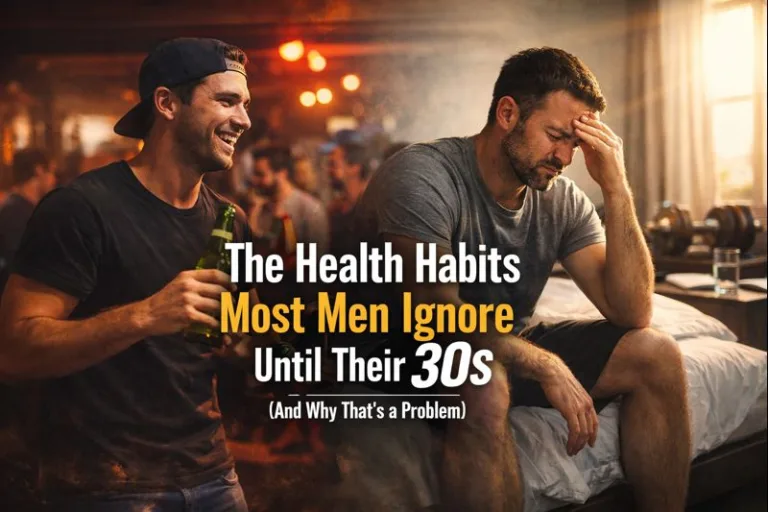
The Health Habits Most Men Ignore Until Their 30s (And Why That’s a Problem)

Most health problems do not appear overnight.

They build slowly through habits that seem harmless in your twenties but become costly in your thirties and beyond. The issue is not that men are careless. It is that many of the most important health habits do not feel urgent until something starts to break.

By the time most men pay attention, they are reacting instead of maintaining.

This article is not about optimization or fear. It is about the habits that quietly matter long before symptoms show up and why ignoring them makes everything harder later.


Why Men Delay Health Until It Feels Necessary

In your twenties, the margin for error is large.
Poor sleep, inconsistent eating, stress, and inactivity often feel recoverable.

In your thirties, that margin shrinks.

What changes is not willpower. What changes is how the body responds to neglect. Recovery slows. Stress compounds. Small issues take longer to resolve.

Health becomes harder not because aging is sudden, but because ignored habits finally demand attention.


1. Sleep Consistency Gets Ignored First

Most men understand that sleep matters. What they underestimate is consistency.

Irregular sleep patterns are associated with:

  • Poor energy regulation

  • Increased stress sensitivity

  • Reduced cognitive performance

Researchers and physicians like Dr. Peter Attia often emphasize that sleep timing matters nearly as much as sleep duration.

Why it gets ignored early
Late nights feel recoverable when responsibilities are lighter.

Why it becomes a problem later
Inconsistent sleep disrupts hormones, recovery, and mental stability over time.

Protecting sleep becomes preventative, not optional.



2. Chronic Stress Feels Normal Until It Is Not

Stress in small amounts is unavoidable. Chronic stress is not harmless.

Long-term elevated stress levels are associated with:

  • Burnout

  • Mood instability

  • Physical tension and fatigue

Most men do not identify as stressed. They identify as busy.

That distinction matters.

Why it gets ignored early
Stress feels productive when output is high.

Why it becomes a problem later
Chronic stress accumulates quietly and affects both mental and physical health.

Stress management is not about relaxation. It is about reducing unnecessary load.


3. Muscle Maintenance Rarely Feels Urgent

Loss of muscle mass does not happen suddenly. It happens gradually through inactivity.

Maintaining muscle supports:

  • Joint stability

  • Metabolic health

  • Long-term mobility

This is one area where prevention is significantly easier than recovery.

Why it gets ignored early
Strength feels abundant when you are younger.

Why it becomes a problem later
Rebuilding lost muscle takes far more effort than maintaining it.

Regular movement and basic strength training are long-term investments.


4. Diet Simplicity Gets Replaced by Convenience

Most men do not fail at nutrition because of ignorance. They fail because complexity and convenience win.

Highly processed foods are easy, available, and engineered to be appealing.

Why it gets ignored early
The body tolerates inconsistency better when you are younger.

Why it becomes a problem later
Diet quality affects energy, mood, weight stability, and recovery.

Simple eating habits tend to outlast complicated plans.

5. Mental Health Gets Addressed Last

Mental strain rarely announces itself clearly. It shows up as irritability, disengagement, or exhaustion.

Psychologists and neuroscientists like Dr. Andrew Huberman frequently emphasize that mental health responds to structure, movement, sleep, and connection more than sudden interventions.

Why it gets ignored early
Men often prioritize performance over processing.

Why it becomes a problem later
Unaddressed mental strain compounds and affects relationships, work, and physical health.

Mental health maintenance works best when it starts before crisis.


6. Preventive Awareness Feels Unnecessary

Many men avoid basic health awareness because it feels excessive or anxiety-inducing.

Preventive awareness does not mean constant testing or obsession. It means understanding baseline health.

Why it gets ignored early
Symptoms are absent, so concern feels unnecessary.

Why it becomes a problem later
Small issues are easier to manage when identified early.

Awareness reduces surprise, not freedom.


What Changes When Men Finally Pay Attention

When men address these habits earlier, several things tend to improve:

  • Energy becomes more stable

  • Stress feels more manageable

  • Physical recovery improves

  • Fewer extreme interventions are needed

Health becomes easier to maintain when it is supported consistently.


This Is Not About Perfection

One of the biggest misconceptions about health is that it requires intensity.

It does not.

Health responds best to:

  • Consistency over time

  • Early course correction

  • Realistic expectations

The earlier these habits are addressed, the less effort they require later.


Final Thought

Most health problems are harder to fix than they are to prevent.

The habits men ignore in their twenties are often the ones they wish they had protected in their thirties.

That is not fear.
That is pattern recognition.


Author Note
Written by Eli, focused on prevention, consistency, and sustainable health habits rather than quick fixes or extremes.

Share your love
Facebook
Twitter
Newsletter

Leave a Reply

Your email address will not be published. Required fields are marked *